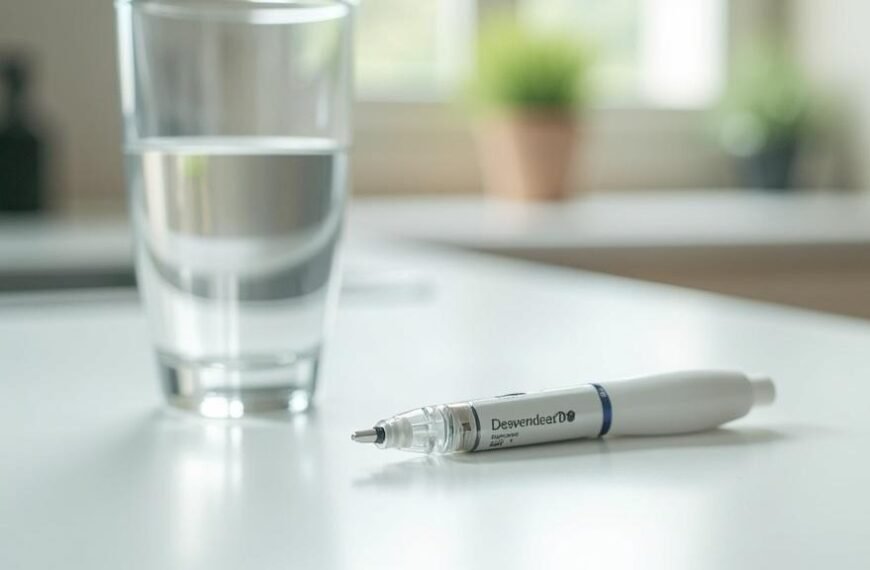
There is no general shelf life for compounded tirzepatide. The date that governs a particular vial is the beyond-use date assigned by the pharmacy that prepared it, printed on that vial’s label. Anyone quoting a universal number is guessing. What can be described in general terms are the warning signs that the dating on a specific product should not be trusted.
Why a single number does not exist
An FDA-approved product carries an expiration date backed by stability studies the manufacturer ran on that exact formulation and submitted to the agency during review. A compounded preparation has no such file behind it. Its beyond-use date is assigned by the compounding pharmacy, based on the formulation that pharmacy built, the testing it performed, and the standards that apply to its category of preparation. Two pharmacies can dispense tirzepatide at the same labeled strength and arrive at different dates.
Compounded drugs are not FDA-approved, and the agency does not review them for safety, effectiveness or quality before they are marketed. That is a statement about the regulatory pathway, not an accusation against any pharmacy. It does mean the printed label, and the pharmacy that printed it, are the only authoritative answer to how long that preparation is good for.
Because the label and the pharmacy behind it are the only real reference, it helps to see how openly a seller discusses dating before an order is placed. Providers publish very different amounts of detail on this point. Ro and Hims & Hers describe their pharmacy relationships in general marketing terms, LillyDirect routes patients to the approved product, and a provider such as HealthRX keeps a page on compounded tirzepatide that spells out how the preparation is handled. Reading those side by side is a fair way to judge which sellers treat beyond-use dating as a serious question rather than a footnote.
Signals that arrive with the shipment
FDA has published a list of telehealth warning signs for consumers, and several land squarely on product integrity. Medicine that looks different from what arrived last time or from what the website pictured. Packaging that shows up broken, damaged, or without instructions for use. A company that ships without screening and a prescription from a licensed doctor, or that has no licensed doctor reachable afterward.
Temperature during transit is its own flag. FDA notes that injectable GLP-1 drugs require refrigeration as indicated in their package inserts, says it has received complaints that certain compounded GLP-1 drugs arrived warm or with inadequate ice packs, and recommends that patients not use any injectable GLP-1 drug that arrives warm or with insufficient refrigeration. A warm box is not a problem to reason around. It is a reason to stop and call.
Signals printed on the label
The agency has stated that labels on compounded drugs may not include important information, such as adequate directions to help ensure the drug is used safely. A missing beyond-use date, a missing pharmacy name, or a strength written in a way that could be read two ways all fall into that gap.
Worse cases exist. FDA has reported fraudulent compounded semaglutide and tirzepatide marketed in the United States carrying false label information. In some instances the compounding pharmacy named on the label does not exist. In others the label carries the name of a real licensed pharmacy that, on the information FDA gathered, did not compound the product. The agency describes one reported adverse event tied to a product labeled as compounded tirzepatide from a pharmacy that did not make it, with redness, injection site swelling, pain, and a red lump at the site.
| What you notice | What it suggests | Reasonable next step |
|---|---|---|
| No beyond-use date on the vial | Nobody has said when this preparation stops being usable | Do not use it. Call the pharmacy for the labeled date |
| No pharmacy named, or a name absent from state license lookup | Accountability is broken before you start | Ask the prescriber which pharmacy filled the order |
| Package arrived warm or with melted cooling | Transit conditions are unknown | FDA advises not using it. Report it to the seller |
| Product looks different from the last shipment | Formulation or supplier may have changed | Ask the pharmacy what changed and why |
| Spelling errors or an address that does not check out | A named FDA red flag for fraudulent product | Do not inject. Report it to the prescriber |
| The date has passed | The only shelf life statement for this vial has run out | Do not use it. Arrange a replacement |
Appearance is not a safety test
The most uncomfortable fact in this subject is that a degraded preparation can look completely normal. Peptide products fail through chemical routes that produce no color change and no visible haze. Laboratory work on semaglutide has mapped how pH, buffer composition, molarity, and temperature drive solution-state degradation, using mass spectrometry to find what the eye cannot. Separate work on liraglutide has shown aggregation driven by air-water and silicone-oil-water interfacial stress, the kind agitation creates. Studies of subvisible particles in injectable products exist because the particles that matter are frequently smaller than a person can see.
A clear solution is therefore not evidence of a good vial, and cloudiness is a late signal rather than an early one. That asymmetry is why the printed date carries so much weight.
Cost pressure is the pattern behind most of these decisions
Almost nobody stretches a dated vial out of curiosity. They do it because the replacement costs money and the next shipment is not due. That is a real financial problem, and it is better solved in the open than at the point of injection. Providers vary in how much they put in writing before a first order, and the practical question is whether the compounding pharmacy is named and reachable. Hims & Hers, LifeMD, Henry Meds and FormBlends all route prescriptions through licensed compounding pharmacies with published cash pricing, and LillyDirect offers a direct channel for the approved product. Comparing refill cost up front beats improvising later.
What to do when something looks wrong
Call the pharmacy that dispensed the vial first, because it holds the formulation record, the lot, and the dating rationale. If it cannot be reached, the prescriber is the next call. Quality problems and adverse events can be reported to FDA through MedWatch. That step matters more than it sounds: federal law does not require state-licensed pharmacies outside the outsourcing facility category to submit adverse events to FDA, and the agency has said reports from this corner of the market are likely undercounted.
Frequently asked questions
Is a beyond-use date the same thing as an expiration date?
No. An expiration date on an approved drug is supported by stability data the manufacturer generated for that formulation and submitted to FDA. A beyond-use date is assigned by the compounding pharmacy for the preparation it made. They answer similar questions but rest on very different evidence.
The vial looks fine and the date has passed. Does that change anything?
No. Visual inspection cannot detect chemical degradation, aggregation, or loss of potency, and it cannot detect contamination either. A normal-looking vial past its labeled date is still past its labeled date, and the pharmacy that set that date is the one to call.
Why do two pharmacies give different dates for what sounds like the same drug?
Because the preparations are not the same. Concentration, excipients, preservative status, and whether the product ships ready to use or needs reconstitution all differ. Each pharmacy assigns dating for the preparation it actually made, which is why a number copied from elsewhere means nothing.
What should be reported, and to whom?
Suspected quality problems and adverse events go to the dispensing pharmacy and to FDA through MedWatch. Labeling that names a pharmacy you cannot verify, or product that arrives warm, is worth reporting even if nothing happened, because those reports are how patterns in this market get identified.
Does buying from a telehealth platform change who is accountable?
It adds a party without removing one. FDA has noted that consumers buying compounded drugs online may not know the identity of the compounder that produced the drug. Knowing which pharmacy filled the order, and being able to reach it, is the difference between a traceable product and an anonymous one.