Infrared vs Finnish Sauna: Heat, Cost, and Research is worth evaluating through the homeowner’s real week, not a perfect catalog photo. The best setup is the one that gets used, stays safe, and does not become a maintenance headache.
My neighbor Dave spent four months last year researching barrel saunas. He read every Reddit thread, watched hours of YouTube tours, bookmarked a dozen spec sheets. Then he bought a 6 kW traditional heater for a cabin sized for 4.5 kW, ran the wiring himself on a 20-amp breaker because “it seemed fine,” and set the whole thing on a gravel pad he tamped down with a hand tool one Saturday afternoon. By February the pad had shifted, the breaker was tripping every session, and the interior benches were already cupping because the builder used flat butt joints instead of tongue-and-groove. Dave’s sauna cost him about $7,200 all in. Then it cost him another $3,400 to fix.
Most sauna projects don’t fail on the product. They fail on the stuff around the product: the pad, the circuit, the sizing math. And the first real decision, infrared or traditional Finnish, shapes nearly every downstream choice you’ll make.
The Energy and Electrical Split
Here’s where infrared and traditional diverge before you ever sit on a bench.
An infrared cabin draws 1.5 to 2 kW and typically runs on a standard 120V household outlet. A traditional electric Finnish heater pulls 6 to 9 kW on a dedicated 240V circuit at 30 to 50 amps. That’s a completely different animal from an electrical standpoint. With infrared, you plug in and go. With traditional, you need a licensed electrician, a permit, and a dedicated run from your main panel.
Per-session energy cost runs roughly two to four times higher for traditional saunas. But the experience is also fundamentally different. Traditional saunas operate at 170 to 200°F with real humidity when you throw water on the stones. Infrared cabins stay at 120 to 150°F and heat your body through radiant panels without meaningfully heating the air. Neither is “better” in some absolute sense. They produce different physiological responses, and which one you prefer is partly a matter of taste, like preferring a hot tub to a cold lake. Both get you wet.
The catch is that most buyers fixate on the unit price and underweight everything else. The same $4,500 kit feels like a steal on a level concrete pad with a clean 240V run from the panel, and feels like a disaster on settled gravel with an undersized circuit. The site work is the project. The sauna is just the thing that sits on top.
What the Research Actually Shows
Sauna research shifted from niche to mainstream after Laukkanen and colleagues published a 20-year prospective cohort study in JAMA Internal Medicine in 2015. They tracked 2,315 middle-aged Finnish men and found a dose-response association between sauna frequency and reduced cardiovascular mortality. Men who used a sauna four to seven times per week had a 50 percent lower risk of fatal cardiovascular events compared to those using it once a week, after adjusting for known risk factors.
A 2018 follow-up from the same group (BMC Medicine) reported a 60 percent lower risk of dementia and Alzheimer’s disease in the highest-frequency users compared with the lowest. The proposed mechanisms include heat-shock protein expression, improved endothelial function, and a heart-rate response similar to moderate-intensity exercise, though the pathway isn’t fully nailed down.
Worth noting: these studies tracked traditional Finnish saunas at high temperatures, not infrared. Infrared has its own smaller body of research showing benefits for chronic pain, blood pressure, and vascular function, but it hasn’t been studied at the same scale or duration. If you’re buying specifically because of the Laukkanen data, that data came from 170°F-plus sessions with steam.
The practical takeaway for a home owner: 20-minute sessions at 170 to 195°F, two to four times per week, fall inside the range that produced the Finnish outcomes. Hydration is non-negotiable. And anyone with arrhythmias, unstable angina, recent cardiac events, uncontrolled hypertension, or who is pregnant needs physician clearance before starting.
Building It Right: Pad, Wiring, Ventilation
A sauna install is half carpentry and half electrical. Most adults can handle the carpentry side of a pre-cut kit with one helper and a free weekend. The electrical side is a different story entirely.
Start with the pad. A 4-inch compacted gravel pad with proper drainage works for barrel units on flat ground. For cabin saunas in cold or wet climates, a 4-inch reinforced concrete slab is the right call, running $4 to $7 per square foot installed. Getting this wrong is expensive to fix after the fact (see: Dave).
Electrical is not optional DIY. A traditional sauna heater on a 240V circuit at 30 to 50 amps requires a licensed electrician. Full stop. They pull the permit, size the breaker correctly, and tie into your panel safely. Cutting corners here is how house fires start, and I’m not being dramatic. I’ve seen charred wire photos from three different forum threads in the last year alone.
Ventilation matters more than people think. An outdoor sauna needs an intake low on the wall under the heater and an adjustable exhaust on the opposite wall near the ceiling. Indoor builds need a passive vent to the outside or a properly sized exhaust fan. Skip this and you get stagnant air, uneven heat, and wood that deteriorates faster.
Permitting varies wildly. Some counties exempt detached structures under 200 square feet from building permits, but the electrical permit is almost always required because of the 240V circuit. Call your local building department before you buy. Not after.
The Real Cost, Not Just the Sticker Price
Budget the whole project, not just the unit.
On the sauna side: $2,490 for an entry-level barrel kit, $6,000 to $10,000 for a mid-tier cabin with a quality heater, $12,000 to $16,980 for a panoramic glass-front or premium thermo-aspen build. Then add $400 to $900 for a gravel pad, $1,200 to $2,400 for concrete, and $600 to $1,800 for the 240V electrical run.
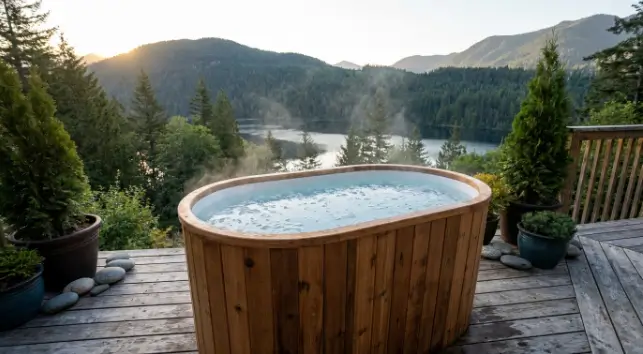
Cold plunges (since many of you are shopping both): $4,500 to $7,500 for a residential insulated tub with integrated chiller, $9,000 to $14,000 for commercial-grade stainless with full filtration. Stock-tank DIY setups run $400 to $900 but require manual ice, which gets old around week three.
Appraisers won’t add dollar-for-dollar value on a sauna, but a well-built outdoor wellness setup is increasingly treated as a selling feature in Northeast and Pacific Northwest markets. It’s more like a nice deck than a pool: it won’t double your property value, but it won’t hurt, and it will get used.
On the tax side, a residential sauna is rarely HSA or FSA eligible unless a clinician writes a Letter of Medical Necessity for a documented condition. Don’t assume it qualifies. Talk to your tax advisor first.
Picking the Right Type for Your Situation
I get asked “which one should I buy?” more than any other question. And the boring truth is that it depends on three things: your electrical situation, your climate, and how you actually want to feel in the sauna.
If you’re in an apartment or a space with no easy 240V access, infrared is the practical choice. It plugs in, heats up in 15 to 20 minutes, and operates at lower temperatures that some people genuinely prefer.
If you want the full Finnish experience (hot stones, steam, that wall-of-heat feeling), traditional is the way. But you’re committing to a real installation project with a proper pad and a dedicated circuit.
For a deeper side-by-side breakdown of sizing, wood species, heater wattage, and install considerations, the Sweat Decks comparison guide is worth bookmarking. It covers specific model lineups and price tiers in a way that’s useful before you start a build.
On spec sheets, regardless of type: pay attention to wood species and joinery. Pre-cut tongue-and-groove cladding in cedar, hemlock, thermo-aspen, or redwood is the standard. Cheap units skip this and use butt joints with felt. Those builds leak heat and look tired within two seasons. Also match the heater to the cabin volume using the manufacturer’s published sizing chart. Undersized heaters run constantly and burn out early. Oversized units cycle hard and waste energy. Forum guesses are not sizing charts.
FAQs
How often does a sauna need maintenance?
Wipe down benches after each session and oil the exterior cedar or hemlock once a year. For cold plunges, replace filter cartridges every 6 to 12 weeks, run ozone or UV on schedule, and drain-and-refill per the manufacturer’s interval.
Will my electric bill spike from a sauna?
A 6 kW sauna heater running one hour costs roughly $0.60 to $1.20 at typical US residential rates. Three 20-minute sessions per week land near $4 to $8 per month. A 1/2 HP cold-plunge chiller in steady state pulls about 350 to 450 watts and adds $8 to $15 monthly in most climates.
Is a sauna safe during pregnancy?
Pregnant adults should not start a new sauna or cold-plunge routine without explicit clearance from their OB-GYN. Core temperature changes carry real fetal risks, especially in early pregnancy. This is a clear case where you defer to your physician, no exceptions.
How loud is a sauna?
A traditional sauna heater is silent in operation. A cold-plunge chiller runs at roughly 45 to 55 dB at one meter (similar to a quiet conversation). Place the unit where the chiller hum won’t bother neighbors or interior bedrooms.
Can I run a sauna year-round in cold climates?
Yes, with caveats. Outdoor saunas are designed for cold weather and benefit from a longer pre-heat schedule in winter. Cold plunges with insulated tubs and integrated chillers handle below-freezing ambient temperatures if the chiller’s operating range allows it. Check the manufacturer’s spec sheet for low-temperature performance limits.
Does infrared produce the same health benefits as traditional?
Infrared has promising smaller-scale research on chronic pain, blood pressure, and vascular function. But the landmark cardiovascular and dementia studies (Laukkanen et al., 2015 and 2018) were conducted with traditional Finnish saunas at higher temperatures. The two types likely produce overlapping but not identical physiological effects.
How big should my sauna be?
For one to two people, a 4×6-foot interior is comfortable. For three to four people, step up to 6×8 feet. Barrel saunas typically seat two to four depending on length. Don’t overbuild for occasional guests and don’t underbuild for daily use. Think about your realistic weekly routine, not the one dinner party a year.
Disclaimer. This article is general consumer information, not medical advice. Heat and cold therapies carry real cardiovascular load. Anyone with arrhythmias, uncontrolled hypertension, Raynaud’s phenomenon, recent cardiac events, or who is pregnant should consult a physician before starting any new sauna or cold-plunge routine.
Any 240V electrical work should be completed by a licensed electrician under the appropriate local permit.
HSA and FSA reimbursement on wellness equipment is patient-specific and depends on a Letter of Medical Necessity from a clinician. Talk to your tax advisor before assuming a purchase qualifies.